Signed in as:
filler@godaddy.com
𝗔𝗰𝘁𝗶𝗼𝗻: Build and adopt 𝗦𝗼𝘂𝗻𝗱, 𝗠𝗮𝗿𝗸𝗲𝘁-𝗕𝗮𝘀𝗲𝗱 𝗠𝗼𝗻𝗲𝘆—𝗲𝗻𝗮𝗯𝗹𝗶𝗻𝗴 𝗣𝗲𝗮𝗰𝗲 & 𝗣𝗿𝗼𝘀𝗽𝗲𝗿𝗶𝘁𝘆—10-year 𝗧𝗿𝗮𝗻𝘀𝗶𝘁𝗶𝗼𝗻 𝗥𝗼𝗮𝗱𝗺𝗮𝗽 to competitive currencies & transparent finance
➡️ 𝗧𝗵𝗲𝘀𝗶𝘀: Monetary structure determines the ability—or inability—of the state to finance large-scale allocation (including “forever wars”)—amplified and sustained through narrative control (propaganda) across government and mainstream media
⠀• Systems with 𝗖𝗲𝗻𝘁𝗿𝗮𝗹𝗹𝘆 𝗗𝗶𝗿𝗲𝗰𝘁𝗲𝗱 𝗠𝗼𝗻𝗲𝘆
⠀ → enable large-scale, sustained allocation (including war)
⠀• Systems with 𝗠𝗮𝗿𝗸𝗲𝘁-𝗗𝗶𝘀𝗰𝗶𝗽𝗹𝗶𝗻𝗲𝗱 𝗠𝗼𝗻𝗲𝘆 & 𝗖𝗿𝗲𝗱𝗶𝘁
⠀ → raise 𝗖𝗼𝘀𝘁 𝗮𝗻𝗱 𝗩𝗶𝘀𝗶𝗯𝗶𝗹𝗶𝘁𝘆
⠀ → improve capital formation, stability and long-term prosperity
➡️ Bridge: Easy money funds 𝗪𝗮𝗿 𝗮𝗻𝗱 𝗕𝘂𝗿𝗲𝗮𝘂𝗰𝗿𝗮𝘁𝗶𝗰 𝗘𝘅𝗽𝗮𝗻𝘀𝗶𝗼𝗻 without immediate taxation. As costs are delayed (𝗜𝗻𝗳𝗹𝗮𝘁𝗶𝗼𝗻, 𝗗𝗲𝗯𝘁), messaging sustains support—allowing these actions to expand and persist
➡️ Anchor: Sound money relies on verifiable scarcity (gold, crypto, hybrid), constraining supply and preventing political expansion
⠀
𝗜. 🪙 𝗠𝗢𝗡𝗘𝗧𝗔𝗥𝗬 𝗙𝗢𝗨𝗡𝗗𝗔𝗧𝗜𝗢𝗡 — Thesis & Enabling Layer
⚡ 𝗧𝗵𝗲 𝗚𝗿𝗲𝗮𝘁 𝗥𝗲-𝗖𝗼𝗻𝘃𝗲𝗿𝗴𝗲𝗻𝗰𝗲—Market-selected money (scarce assets: gold, crypto, GBC) meets accelerating cloud-scale classical + AI + quantum computing—enabling an emergent, real-time, tamper-resistant distributed economic network
🌍 𝗙𝗼𝗿 𝘁𝗵𝗲 𝗳𝗶𝗿𝘀𝘁 𝘁𝗶𝗺𝗲—𝗮 𝗽𝗲𝗮𝗰𝗲-𝗯𝗮𝘀𝗲𝗱 and 𝗽𝗿𝗼𝘀𝗽𝗲𝗿𝗼𝘂𝘀 𝗵𝗶𝗴𝗵-𝗴𝗿𝗼𝘄𝘁𝗵 𝗳𝗿𝗲𝗲-𝗺𝗮𝗿𝗸𝗲𝘁 𝘀𝘆𝘀𝘁𝗲𝗺 is possible at scale—powered by accelerating cloud-scale classical, multi-agent AI autonomous workforce and emerging quantum computing—enhancing economic calculation, speed, coordination and decentralization
⠀
⚠️ 𝗖𝗢𝗥𝗘 𝗣𝗥𝗢𝗕𝗟𝗘𝗠
Central control of money and credit distorts price signals, delays information and shifts resource allocation from economic to political decisions
𝗜𝗻𝗳𝗹𝗮𝘁𝗶𝗼𝗻 & 𝗗𝗲𝗯𝘁 (> $39T and rising; ≈$2T/yr deficits)
➡️ 𝗥𝗲𝘀𝘂𝗹𝘁
• 𝗜𝗻𝗳𝗹𝗮𝘁𝗶𝗼𝗻 (purchasing power erosion; hidden tax & redistribution)
• Capital misallocation
• Boom–bust cycles
• Systemic instability
→ expands state scope (deficit-financed war, bureaucracy)
⚖️ 𝗦𝘆𝘀𝘁𝗲𝗺 𝗢𝘂𝘁𝗰𝗼𝗺𝗲
Sound money + competitive finance + transparent information systems
→ improved fiscal discipline, reduced distortion and constrained capacity for large-scale deficit-financed conflict (e.g. endless wars), lowering escalation risk
⠀
⚙️ 𝗔𝗥𝗖𝗛𝗜𝗧𝗘𝗖𝗧𝗨𝗥𝗘 & 𝗠𝗘𝗖𝗛𝗔𝗡𝗜𝗦𝗠𝗦
🔍 𝗨𝗻𝗱𝗲𝗿𝗹𝘆𝗶𝗻𝗴 𝗔𝘀𝘀𝗲𝘁𝘀 (Scarcity Base)
→ Market-chosen currencies — open competition
→ Primary forms:
⠀→ Gold + Decentralized Crypto + Gold-Backed Crypto (GBC)
→ 🏦 Private Banks & Credit Markets
→ ⚖️ Market Discipline
→ 📊 Price Signals → Economic Calculation → Entrepreneurial Discovery
→ 📈 Economic Growth
🏦 𝗣𝗿𝗶𝘃𝗮𝘁𝗲 𝗕𝗮𝗻𝗸𝗶𝗻𝗴 & 𝗜𝘀𝘀𝘂𝗮𝗻𝗰𝗲
⠀• Competing banks issue credit backed by scarce assets
⠀• Convertibility enforces redemption discipline
⠀• Overissuance triggers reserve drain and failure risk
➡️ 𝗖𝗿𝗲𝗱𝗶𝘁 𝗖𝗿𝗲𝗮𝘁𝗶𝗼𝗻 𝗶𝘀 𝗠𝗮𝗿𝗸𝗲𝘁-𝗕𝗼𝘂𝗻𝗱—𝗡𝗼𝘁 𝗣𝗼𝗹𝗶𝗰𝘆-𝗗𝗶𝗿𝗲𝗰𝘁𝗲𝗱
⠀
🔐 𝗦𝗰𝗮𝗿𝗰𝗶𝘁𝘆 𝗞𝗲𝘆 𝗙𝗮𝗰𝘁𝗼𝗿𝘀 — Core Mechanisms
🔵 𝗖𝗿𝘆𝗽𝘁𝗼 (Algorithmic Scarcity)
⠀• ⛔ Hard cap (e.g. Bitcoin 21M)
⠀• ✂️ Halving (~50% issuance reduction)
⠀• 🔑 Lost keys reduce circulating supply
⠀• 🔥 Token burning (select systems)
🟡 𝗚𝗼𝗹𝗱 (Physical Scarcity)
⠀• 🌍 Finite, geologically constrained
⠀• ⛏️ Rising extraction cost
⠀• 📉 Slow supply growth (~1–2%)
🪙 𝗛𝘆𝗯𝗿𝗶𝗱 (𝗚𝗕𝗖)
⠀• 🏦 Gold-backed issuance
⠀• 🔍 Auditable reserves
⠀• ⛓️ Blockchain verification
➡️ 𝗥𝗲𝘀𝘂𝗹𝘁: 𝗦𝗰𝗮𝗿𝗰𝗶𝘁𝘆 𝗶𝘀 𝗲𝗻𝗳𝗼𝗿𝗰𝗲𝗱 𝗮𝘁 𝗯𝗼𝘁𝗵 𝗮𝘀𝘀𝗲𝘁 𝗮𝗻𝗱 𝗶𝘀𝘀𝘂𝗮𝗻𝗰𝗲 𝗹𝗮𝘆𝗲𝗿𝘀
⠀
🏛 𝗙𝗶𝗮𝘁 / 𝗖𝗲𝗻𝘁𝗿𝗮𝗹𝗹𝘆 𝗗𝗶𝗿𝗲𝗰𝘁𝗲𝗱 𝗠𝗼𝗻𝗲𝘆
⠀• Central bank creates base money (reserves, currency)
⠀• Commercial banks expand supply via credit creation
⠀• Elastic supply guided by policy (monetary + fiscal)
⠀• Costs deferred (inflation, debt)
⠀
💰 𝗖𝗮𝗻𝘁𝗶𝗹𝗹𝗼𝗻 𝗘𝗳𝗳𝗲𝗰𝘁 — Hidden redistribution (fiat / credit-based systems)
New money enters asymmetrically—benefiting early recipients (government, financial institutions, connected sectors) before prices adjust. By the time it reaches wage earners, purchasing power has already declined
➡️ Effect: quiet wealth transfer, asset inflation, and large-scale spending (including war) without immediate taxation
⠀
⚖️ 𝗖𝗼𝗺𝗽𝗲𝘁𝗶𝗻𝗴 𝗩𝗶𝗲𝘄𝘀 (Market Selection)
⠀• 🤝 𝗦𝗵𝗮𝗿𝗲𝗱 𝗴𝗼𝗮𝗹: Non-fiat, scarce, market-based money
⠀• 🔵 Crypto-first: Code-enforced supply, portability, no custodians (tradeoff: volatility)
⠀• 🟡 Gold / free-banking: Stability, long-term store of value (tradeoff: custody, slower settlement)
⠀• 🪙 Hybrid (GBC): Gold stability + blockchain transfer (tradeoff: trust/verification layer)
⠀• 🔄 Observed: Capital rotates—crypto (growth/innovation) ↔ gold (stability in stress)
➡️ 𝗞𝗲𝘆: Let markets—not doctrine—select among competing forms over time
⠀
🧠 𝗖𝗮𝘂𝘀𝗮𝗹 𝗖𝗹𝗮𝗿𝗶𝗳𝗶𝗰𝗮𝘁𝗶𝗼𝗻
Monetary systems influence how economic activity and state actions are financed—not whether they occur
⠀• Sound money constrains hidden monetary expansion (e.g. inflationary financing)
⠀• Increases reliance on visible mechanisms (taxation, borrowing)
⠀• Improves transparency and fiscal discipline
➡️ Effect:
⠀• Raises the cost and visibility of sustained deficit spending
⠀• Reduces hidden redistribution mechanisms
➡️ Constraint linkage:
⠀• Monetary constraint and legal accountability together limit incentives for coercion and large-scale conflict (war)
➡️ Monetary structure determines how power is financed; governance and rights determine how it is constrained
⠀
⚖️ 𝗚𝗢𝗩𝗘𝗥𝗡𝗔𝗡𝗖𝗘, 𝗥𝗜𝗚𝗛𝗧𝗦 & 𝗦𝗬𝗦𝗧𝗘𝗠 𝗢𝗨𝗧𝗖𝗢𝗠𝗘𝗦
🔴 War-Driven Central Bank System
🏛 Central bank → expanded state capacity
↘ funds military spending (e.g. perpetual wars) & welfare programs
💸 Low rates → bailouts → debt & inflation
↘ drives boom–bust cycles
🧠 Narrative / Information Layer — Gov. Propaganda (section II)
↘ aligns public perception with state objectives
↘ sustains large-scale allocation
⠀
━━━━━━━━━━━━
☢️ 𝗘𝘀𝗰𝗮𝗹𝗮𝘁𝗶𝗼𝗻 𝗥𝗶𝘀𝗸
━━━━━━━━━━━━
↘ sustained, large-scale conflict increases the probability of 𝗰𝗮𝘁𝗮𝘀𝘁𝗿𝗼𝗽𝗵𝗶𝗰 𝗼𝘂𝘁𝗰𝗼𝗺𝗲𝘀, including 𝗻𝘂𝗰𝗹𝗲𝗮𝗿 𝗲𝘀𝗰𝗮𝗹𝗮𝘁𝗶𝗼𝗻 and potential 𝗰𝗶𝘃𝗶𝗹𝗶𝘇𝗮𝘁𝗶𝗼𝗻-𝘀𝗰𝗮𝗹𝗲 𝗿𝗶𝘀𝗸
⠀
━━━━━━━━━━━━
⚖️ 𝗖𝗼𝗻𝘀𝘁𝗿𝗮𝗶𝗻𝘁𝘀 𝗼𝗻 𝗣𝗼𝘄𝗲𝗿 — Founders, Libertarian & Reform Perspective
━━━━━━━━━━━━
• 𝗠𝗶𝗻𝗶𝗺𝗮𝗹 𝗴𝗼𝘃𝗲𝗿𝗻𝗺𝗲𝗻𝘁 requires 𝗹𝗶𝗺𝗶𝘁𝗲𝗱 𝗮𝗻𝗱 𝘃𝗶𝘀𝗶𝗯𝗹𝗲 𝘁𝗮𝘅𝗮𝘁𝗶𝗼𝗻—constraining state expansion—with some advocating further reduction, repeal of the income tax (16th Amendment), or abolition (“taxation is theft” — Rothbard, “government is a necessary evil” — Paine) → 𝗰𝗼𝗻𝘀𝘁𝗿𝗮𝗶𝗻𝗲𝗱, 𝗺𝗶𝗻𝗶𝗺𝗮𝗹 𝗴𝗼𝘃𝗲𝗿𝗻𝗺𝗲𝗻𝘁
• Legal accountability + monetary constraints → enforceable human rights (domestic/international) → constrain coercive power
↘ 𝗗𝗲𝗽𝗿𝗶𝘃𝗮𝘁𝗶𝗼𝗻 𝗼𝗳 𝗿𝗶𝗴𝗵𝘁𝘀 𝘂𝗻𝗱𝗲𝗿 𝗰𝗼𝗹𝗼𝗿 𝗼𝗳 𝗹𝗮𝘄 (18 U.S.C. § 242) → enforcement strengthened (lower mens rea) — as proposed by the Justice in Policing Act
↘ 𝗤𝘂𝗮𝗹𝗶𝗳𝗶𝗲𝗱 𝗶𝗺𝗺𝘂𝗻𝗶𝘁𝘆 → restricted/overridden (JiPA) → abolition proposed by libertarian Justin Amash via the Ending Qualified Immunity Act
↘ 𝗦𝘂𝗽𝗿𝗲𝗺𝗲 𝗶𝗻𝗱𝗲𝗽𝗲𝗻𝗱𝗲𝗻𝘁 𝗰𝗼𝗻𝘀𝘁𝗶𝘁𝘂𝘁𝗶𝗼𝗻𝗮𝗹 𝗰𝗼𝘂𝗿𝘁𝘀 → due process, judicial review, remedies
↘ 𝗜𝗻𝘁𝗲𝗿𝗻𝗮𝘁𝗶𝗼𝗻𝗮𝗹 𝗮𝗰𝗰𝗼𝘂𝗻𝘁𝗮𝗯𝗶𝗹𝗶𝘁𝘆 𝗹𝗮𝘆𝗲𝗿 → join the International Criminal Court (Rome Statute) to prevent/prosecute genocide, crimes against humanity, war crimes
➡️ 𝗦𝘆𝘀𝘁𝗲𝗺 𝗼𝘂𝘁𝗰𝗼𝗺𝗲 → reduced rights violations and lower propensity for sustained large-scale conflict
➡️ Outcome: centralized control is replaced by decentralized, market-driven coordination of capital and resources
➡️ This framework is descriptive—not centrally designed, but emerges through competition
➡️ 𝗦𝘆𝘀𝘁𝗲𝗺 𝗠𝗲𝗰𝗵𝗮𝗻𝗶𝘀𝗺: Capacity enables action; legitimacy sustains it—via narrative in fiat systems and via price signals and market discipline in sound systems
⠀
✨ 𝗞𝗲𝘆 𝗖𝗼𝗻𝗰𝗲𝗽𝘁
⠀• Peace-Driven Systems (market-coordinated, sound money, disciplined credit, decentralized decision-making)
⠀→ constrain large-scale, sustained resource mobilization → lower structural incentives for prolonged conflict
⠀• War-Driven Systems (centrally directed money and credit, inflation-prone, boom–bust, resource distortion)
⠀→ enable rapid, large-scale financing → support sustained military engagement
💰 Taxation & control → resources diverted from the market allocation
➡️ As financial constraints weaken, informational alignment becomes necessary to sustain the system
⠀
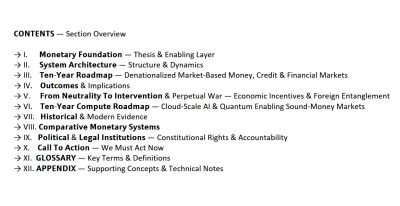
👉 𝗖𝗢𝗡𝗧𝗘𝗡𝗧𝗦 — Section Overview
→ I. 𝗠𝗼𝗻𝗲𝘁𝗮𝗿𝘆 𝗙𝗼𝘂𝗻𝗱𝗮𝘁𝗶𝗼𝗻 — Thesis & Enabling Layer
→ II. 𝗦𝘆𝘀𝘁𝗲𝗺 𝗔𝗿𝗰𝗵𝗶𝘁𝗲𝗰𝘁𝘂𝗿𝗲 — Structure & Dynamics
→ III. 𝗧𝗲𝗻-𝗬𝗲𝗮𝗿 𝗥𝗼𝗮𝗱𝗺𝗮𝗽 — Denationalized Market-Based Money, Credit & Financial Markets
→ IV. 𝗢𝘂𝘁𝗰𝗼𝗺𝗲𝘀 & Implications
→ V. 𝗙𝗿𝗼𝗺 𝗡𝗲𝘂𝘁𝗿𝗮𝗹𝗶𝘁𝘆 𝗧𝗼 𝗜𝗻𝘁𝗲𝗿𝘃𝗲𝗻𝘁𝗶𝗼𝗻 & Perpetual War — Economic Incentives & Foreign Entanglement
→ VI. 𝗧𝗲𝗻-𝗬𝗲𝗮𝗿 𝗖𝗼𝗺𝗽𝘂𝘁𝗲 𝗥𝗼𝗮𝗱𝗺𝗮𝗽 — Cloud-Scale AI & Quantum Enabling Sound-Money Markets
→ VII. 𝗛𝗶𝘀𝘁𝗼𝗿𝗶𝗰𝗮𝗹 & Modern Evidence
→ VIII. 𝗖𝗼𝗺𝗽𝗮𝗿𝗮𝘁𝗶𝘃𝗲 𝗠𝗼𝗻𝗲𝘁𝗮𝗿𝘆 𝗦𝘆𝘀𝘁𝗲𝗺𝘀
→ IX. 𝗣𝗼𝗹𝗶𝘁𝗶𝗰𝗮𝗹 & 𝗟𝗲𝗴𝗮𝗹 𝗜𝗻𝘀𝘁𝗶𝘁𝘂𝘁𝗶𝗼𝗻𝘀 — Constitutional Rights & Accountability
→ X. 𝗖𝗮𝗹𝗹 𝗧𝗼 𝗔𝗰𝘁𝗶𝗼𝗻 — We Must Act Now
→ XI. 📘 𝗚𝗟𝗢𝗦𝗦𝗔𝗥𝗬 — Key Terms & Definitions
→ XII. 📎 𝗔𝗣𝗣𝗘𝗡𝗗𝗜𝗫 — Supporting Concepts & Technical Notes
⠀
𝗜𝗜. ⚙️ 𝗦𝗬𝗦𝗧𝗘𝗠 𝗔𝗥𝗖𝗛𝗜𝗧𝗘𝗖𝗧𝗨𝗥𝗘 — Structure & Dynamics
🔄 𝗠𝗔𝗥𝗞𝗘𝗧 𝗗𝗬𝗡𝗔𝗠𝗜𝗖𝗦
🔄 𝗠𝗮𝗿𝗸𝗲𝘁-𝗗𝗿𝗶𝘃𝗲𝗻 𝗠𝗼𝗻𝗲𝘁𝗮𝗿𝘆 𝗠𝗶𝘅 (dynamic)
⠀• No single monetary standard is imposed
⠀• Gold, crypto and gold-backed digital assets compete and coexist
⠀• The optimal mix is determined by market preference, trust and use case
🌍 𝗠𝘂𝗹𝘁𝗶-𝗟𝗲𝘃𝗲𝗹 𝗔𝗱𝗮𝗽𝘁𝗮𝘁𝗶𝗼𝗻
⠀• 𝗟𝗼𝗰𝗮𝗹 → May Favor Physical Gold or Stable Instruments — Tangible Trust, Low-Tech Resilience
⠀• 𝗥𝗲𝗴𝗶𝗼𝗻𝗮𝗹 → Hybrid Banking Systems — Regulatory Integration, Credit Intermediation, Cross-Border Coordination
⠀• 𝗚𝗹𝗼𝗯𝗮𝗹 → Crypto/Digital Settlement Layers — e.g. Bitcoin: Borderless, Protocol-Based; Minutes On-Chain, Near-Instant/Low-Cost via Second-Layer Networks (e.g. Lightning) vs Slower and Often Higher-Cost, Jurisdiction-Bound Government-Regulated Financial Systems
⚖️ 𝗞𝗲𝘆 𝗣𝗿𝗶𝗻𝗰𝗶𝗽𝗹𝗲
➡️ Competition—not central design—determines outcomes
➡️ Monetary structure determines capacity; information systems determine sustained capacity
⠀
🧠 𝗜𝗡𝗙𝗢𝗥𝗠𝗔𝗧𝗜𝗢𝗡 & 𝗡𝗔𝗥𝗥𝗔𝗧𝗜𝗩𝗘 𝗖𝗢𝗡𝗧𝗥𝗢𝗟 — Propaganda — Legitimacy Layer
• 𝗙𝘂𝗻𝗰𝘁𝗶𝗼𝗻
Aligns perception with large-scale allocation when costs are indirect, delayed or opaque
• 𝗣𝗼𝘀𝗶𝘁𝗶𝗼𝗻 𝗜𝗻 𝗧𝗵𝗲 𝗦𝘆𝘀𝘁𝗲𝗺
Monetary expansion → narrative alignment → policy execution (spending, military, programs)
🧩 𝗠𝗲𝗰𝗵𝗮𝗻𝗶𝘀𝗺𝘀
1. 𝗡𝗮𝗿𝗿𝗮𝘁𝗶𝘃𝗲 𝗙𝗿𝗮𝗺𝗶𝗻𝗴
⠀• Presents actions as necessity (security, stability, crisis response)
⠀• Frames existential threats (strategic or national survival scenarios)
2. 𝗧𝗵𝗿𝗲𝗮𝘁 𝗔𝗺𝗽𝗹𝗶𝗳𝗶𝗰𝗮𝘁𝗶𝗼𝗻
⠀• Emphasizes risk → creates urgency → justifies scale and speed
3. 𝗖𝗼𝘀𝘁 𝗢𝗯𝗳𝘂𝘀𝗰𝗮𝘁𝗶𝗼𝗻
⠀• Inflation (hidden tax), debt (deferred burden), complexity
⠀⠀→ reduces visibility of trade-offs and resistance
4. 𝗜𝗱𝗲𝗻𝘁𝗶𝘁𝘆 𝗔𝗹𝗶𝗴𝗻𝗺𝗲𝗻𝘁
⠀• “Us vs. them” cohesion → narrows discourse, increases compliance
5. 𝗥𝗲𝗽𝗲𝘁𝗶𝘁𝗶𝗼𝗻 & 𝗗𝗶𝘀𝘁𝗿𝗶𝗯𝘂𝘁𝗶𝗼𝗻
⠀• High-frequency messaging across media systems
⠀⠀→ familiarity → perceived legitimacy
🔁 𝗙𝗲𝗲𝗱𝗯𝗮𝗰𝗸 𝗟𝗼𝗼𝗽
Spending expands
⠀→ narrative justifies
⠀→ public acceptance holds
⠀→ expansion continues
🧠 𝗦𝘆𝘀𝘁𝗲𝗺 𝗜𝗻𝘀𝗶𝗴𝗵𝘁
As cost visibility decreases, reliance on narrative alignment increases
➡️ 𝗠𝗼𝗻𝗲𝘁𝗮𝗿𝘆 𝗖𝗮𝗽𝗮𝗰𝗶𝘁𝘆 enables scale; 𝗡𝗮𝗿𝗿𝗮𝘁𝗶𝘃𝗲 𝗔𝗹𝗶𝗴𝗻𝗺𝗲𝗻𝘁 (propaganda) sustains it
➡️ Transparent, market-based systems reduce reliance on 𝗺𝗮𝗻𝘂𝗳𝗮𝗰𝘁𝘂𝗿𝗲𝗱 𝗻𝗮𝗿𝗿𝗮𝘁𝗶𝘃𝗲𝘀
🧠 In practice
Different systems will emerge simultaneously—some gold-heavy, some crypto-native, many hybrid—evolving over time
⠀
𝗜𝗜𝗜. 🧭 𝗧𝗘𝗡-𝗬𝗘𝗔𝗥 𝗥𝗢𝗔𝗗𝗠𝗔𝗣 — Denationalized Market-Based Money, Credit & Financial Markets
➡️ Overview: Transition from fiat monopoly → competitive, market-based money
➡️ 𝗣𝗮𝗿𝗮𝗹𝗹𝗲𝗹 𝗟𝗮𝘆𝗲𝗿: Section VI presents the compute roadmap—AI, cloud and quantum—scaling over the same timeline to enable, accelerate and validate the transition
🗺️ 𝗥𝗢𝗔𝗗𝗠𝗔𝗣 (𝗣𝗛𝗔𝗦𝗘𝗗 𝗘𝗫𝗘𝗖𝗨𝗧𝗜𝗢𝗡)
⠀Market-based money emerges via private innovation, capital and legal frameworks—government permits or blocks but does not design it
⠀
🟢 𝗣𝗵𝗮𝘀𝗲 𝟭: Parallel Use (0–2 years)
• Wallets + payments widely available
• Early adopters: freelancers, merchants, exporters
• GBC for stability, crypto for rails, fiat as bridge
🟡 𝗣𝗵𝗮𝘀𝗲 𝟮: Competition (2–5 years)
• Private banks compete on transparency and discipline
• Merchant & payroll adoption expand
• Regulatory friction begins to decline
🔵 𝗣𝗵𝗮𝘀𝗲 𝟯: Normalization (5–10 years)
• Multi-currency pricing becomes common
• Capital flows to most credible monetary systems
• Weak models lose share through market discipline
🟣 𝗣𝗵𝗮𝘀𝗲 𝟰: Market Selection (ongoing)
• No single system dominates
• Different mixes emerge by use case
• Continuous evolution driven by trust and performance
⠀
⚠️ 𝗖𝗼𝗻𝘀𝘁𝗿𝗮𝗶𝗻𝘁𝘀 & 𝗠𝗶𝘁𝗶𝗴𝗮𝘁𝗶𝗼𝗻
⠀• Custodial risk → diversify custody + audits
⠀• Smart contract risk → conservative design + review
⠀• Liquidity fragmentation → interoperable systems
⠀• Policy friction → start where neutrality exists
⠀
🔑 𝗘𝘅𝗲𝗰𝘂𝘁𝗶𝗼𝗻 𝗥𝘂𝗹𝗲𝘀
⠀• Build better products, not just theory
⠀• Focus on payments, payroll, cross-border use
⠀• Make transparency visible and comparable
⠀• Let usage lead, not ideology
⠀⠀
🧾 𝗕𝗼𝘁𝘁𝗼𝗺 𝗟𝗶𝗻𝗲
⠀Denationalized money emerges through competition—not decree
⠀Build viable alternatives, reduce friction, prove transparency—and the market selects the system
⠀
🧩 𝗔𝗰𝘁𝗼𝗿𝘀 (Who Enables This)
⠀• Private sector: builds infrastructure (BTC/Ethereum rails, custody, payments, banking)
⠀• Capital: VC, family offices, macro funds → funds infrastructure, liquidity and adoption
⠀• Government: enables or blocks (legislatures, regulators, courts) → legal neutrality, property rights, tax clarity
⠀• Policy/intellectual layer: economists, legal scholars, think tanks → frameworks, policy influence, legitimacy
⠀• Jurisdictions: adoption starts where regulation is lighter and competition allowed → spreads via cross-border flows and capital movement
⠀• Adoption requires alignment: builders + users + capital + policy → if any fail, adoption stalls
⠀• Path: better private rails → niche adoption → merchants → payroll/contracts → regulatory adaptation → normalization
➡️ Adoption is bottom-up (market-driven), constrained or permitted top-down (policy)
⠀
➡️ With these actors and conditions in place, the system operates—and processes information—as follows:
⠀
🧭 𝗧𝗿𝗮𝗻𝘀𝗶𝘁𝗶𝗼𝗻 𝗣𝗮𝘁𝘁𝗲𝗿𝗻𝘀 (Non-Linear)
• Varies by jurisdiction; policy may accelerate or block
• Crisis → adoption acceleration (banking stress, inflation, capital controls)
• Gresham → Thiers' shift: as fiat volatility rises, merchants demand settlement in sound assets (GBC/BTC)
➡️ Transition occurs via competition, disruption and regulatory adaptation—not a smooth rollout
⠀
🧭 𝗙𝗜𝗔𝗧 𝗠𝗢𝗡𝗢𝗣𝗢𝗟𝗬 𝗧𝗢 𝗠𝗔𝗥𝗞𝗘𝗧 𝗠𝗢𝗡𝗘𝗬
🎯 𝗚𝗼𝗮𝗹
Competitive monetary ecosystem: Gold + Crypto + Hybrid (GBC)
→ Market-selected money; price signals reflect scarcity; credit aligns with real savings
🧠 𝗦𝘁𝗿𝗮𝘁𝗲𝗴𝘆
• Compete on utility (cost, speed, transparency)—not mandates
• Parallel adoption alongside fiat
• Lower switching costs for users and businesses
• Transparency as trust (proof-of-reserves/liabilities + audits)
• Jurisdictional plurality (local → global variation)
🧩🧩 𝗕𝘂𝗶𝗹𝗱
• Infrastructure: wallets, payments (POS/payroll), custody (self + institutional)
• Finance: private banks, GBC accounts, savings-based lending, real-time reserve proofs
• Legal: neutral tax, clear property rights, contract freedom, computational rights
• Transparency: on-chain verification + independent audits (gold/GBC)
• Security: transition to post-quantum cryptography (PQC)
• Adoption: merchants → payroll/contracts → cross-border expansion
⠀
📡 𝗜𝗡𝗙𝗢𝗥𝗠𝗔𝗧𝗜𝗢𝗡, 𝗘𝗖𝗢𝗡𝗢𝗠𝗜𝗖 𝗖𝗔𝗟𝗖𝗨𝗟𝗔𝗧𝗜𝗢𝗡 & 𝗞𝗡𝗢𝗪𝗟𝗘𝗗𝗚𝗘
Centralized systems rely on delayed, aggregated and model-driven data. Systematically distorted by:
• revision cycles
• model uncertainty
• institutional incentives
• Government policy relies on delayed statistics and models
• Price controls and monetary intervention distort signals
• Information is fragmented and often outdated
• Slow feedback loops drive misallocation and instability
Markets process information dynamically through voluntary exchange and price signals:
⠀• Prices encode real-time supply, demand and risk
⠀• Profit and loss provide continuous feedback on resource allocation
⠀• Decentralized actors act instantly on local knowledge
⠀
⚡ Key Contrast:
Markets process information dynamically, while centralized systems react after the fact—leading to misallocation, lag and systemic instability
⠀
➡️ Constraint: This process remains inherently decentralized and adaptive—shaped by uncertainty, local knowledge and human judgment rather than any centralized or fully computable solution
🧠➡️ This framework structures incentives and information flows to systematically improve outcomes—without assuming perfect knowledge or deterministic results
🤖 𝗤𝘂𝗮𝗻𝘁𝘂𝗺 𝗘𝗱𝗴𝗲
Optimization (e.g. annealing, D-Wave) improves specific problems (logistics, portfolios)—enhancing efficiency, not replacing market-based economic coordination
🏦 Financial system (private):
⠀• Custody: gold, crypto, deposits
⠀• Lending: aligned with real savings
⠀• Payments: competitive, efficient intermediation
⠀
🔐 Cryptographic Auditing & Transparency
⠀• On-chain proof of reserves/liabilities → near real-time solvency
⠀• Independent audits (gold) → custody validation
⠀• Public verifiability → reduced information asymmetry
➡️ Result: Loss of transparency → loss of trust → capital exit
⠀
⚠️ Residual risks
⠀• Custodial failure
⠀• Smart contract vulnerabilities
⠀• Systemic shocks
Mitigated via competition, diversification and transparency
⚖️ 𝗥𝗲𝘀𝘂𝗹𝘁
Market discipline + cryptographic verification replace centralized oversight where feasible
⠀
𝗜𝗩. ⚖️ 𝗢𝗨𝗧𝗖𝗢𝗠𝗘𝗦 & 𝗜𝗠𝗣𝗟𝗜𝗖𝗔𝗧𝗜𝗢𝗡𝗦
⚖️ System Effect → Market Discipline
⠀• Reduces boom–bust cycles (ABCT): limits malinvestment by aligning interest rates with real savings
⠀• Historical Evidence: Scotland (1716–1845) demonstrated relative stability and financial innovation under free banking
⠀• Disruption: Bank Act 1845 & UK centralization → note issuance restrictions, legal harmonization with England, gradual shift toward centralized control
⠀
🛡️ Fiscal Constraint
Without a printing press, government must live within its means—through taxation and borrowing, not inflation as a hidden tax
Some frameworks advocate minimal or no taxation, emphasizing voluntary funding and limited government
➡️ In all cases, fiscal discipline becomes unavoidable
⠀
🏛️ Political & Legal Framework
⠀• Abolition of Legal Tender Laws: enables choice in money and voluntary exchange
⠀• Free Banking: removes monopolies and allows competing currencies
⠀• Contract Enforcement: enforcement of voluntary agreements
⠀
Sources (selected):
⠀• Hayek — *Denationalisation of Money*
⠀• Rothbard — *The Case Against the Fed*
⠀• Selgin — free banking research
⠀• Mises Institute — ABCT & sound money literature
⠀• EPICENTER — free banking historical analysis
⠀
🏦 Market-based credit & interest rates → entrepreneurship
⠀↘ free trade & innovation
⠀
🌱 Stability & growth → support conditions for peace and prosperity
⠀
⚖️ 𝗦𝗬𝗦𝗧𝗘𝗠 𝗖𝗢𝗡𝗧𝗥𝗔𝗦𝗧 — War-Driven vs Market-Driven Money
🔴 War-Driven Central Bank System
⠀• Fiat issuance → elastic supply → state financing (war, bureaucracy)
⠀• Credit & rates centrally set → distorted price signals
⠀• Resource allocation → political, not economic
⠀• Crisis response → bailouts + inflation
⠀• Outcome → boom–bust cycles, inefficiency, conflict
🟢 Market-Driven Money & Credit
⠀• Gold + Crypto → Private banks → Market discipline
⠀• Price signals → Economic calculation → Capital allocation
⠀• AI/Quantum → analytics, optimization, risk transparency
⠀• Outcome → coordination, growth, capital efficiency, prosperity
🤖 Role of AI & Quantum
⠀• Modeling, prediction, optimization—not central control
⠀• Enhance market signals; do not replace price discovery
🌍 Peace & Prosperity Loop
⠀• Sound money → no war finance
⠀• Market rates → efficient investment
⠀• Transparency → trust and capital formation
⠀• Entrepreneurship → voluntary wealth creation
📜 Historical insight
⠀• Central banks expanded to finance war and deficits
⠀• Result → inflation cycles, moral hazard, boom–bust dynamics
➡️ Bottom Line:
Market-based money disciplines capital and constrains war financing—enabling coordination, stability and long-term prosperity
⠀
𝗩. 🌍 𝗙𝗥𝗢𝗠 𝗡𝗘𝗨𝗧𝗥𝗔𝗟𝗜𝗧𝗬 𝗧𝗢 𝗜𝗡𝗧𝗘𝗥𝗩𝗘𝗡𝗧𝗜𝗢𝗡 & 𝗣𝗘𝗥𝗣𝗘𝗧𝗨𝗔𝗟 𝗪𝗔𝗥 — Economic Incentives & Foreign Entanglement
⠀
📜 The United States adopted an early policy of neutrality in foreign conflicts (e.g., 1793 Proclamation)
🟢 1793–1917: The U.S. generally maintained neutrality for over a century, prioritizing domestic growth and diplomacy over foreign military expansion
🟢 1935–1941: Strict Neutrality Acts enforced a policy of non-intervention, keeping American resources dedicated to peaceful pursuits
🌍 𝐔.𝐒. 𝐍𝐞𝐮𝐭𝐫𝐚𝐥𝐢𝐭𝐲: 𝐀 𝐋𝐞𝐠𝐚𝐜𝐲 𝐨𝐟 𝐏𝐞𝐚𝐜𝐞 𝐁𝐫𝐨𝐤𝐞𝐧 𝐛𝐲 𝐏𝐫𝐨𝐟𝐢𝐭
• 1793–1917: Broadly honored George Washington’s principle of non-intervention—until Woodrow Wilson. Despite campaigning on peace, Wilson allowed Wall Street and munitions producers to entangle the nation in Allied war efforts. Wilson also drafted the Treaty of Versailles, imposing punitive reparations on Germany, contributing to World War II
⠀➡️ Contrast: inherent rights—not government-granted → rejects Wilson’s progressivism through today
⠀⠀• Merchants of Death: Entry into WWI followed financial entanglement with Allies, incentivizing intervention—investigated and exposed by the Nye Committee
⠀• 1917: Exactly one week after U.S. entry into WWI, Germany facilitated Vladimir Lenin’s return to Russia → Bolshevik Revolution → Russia exits war → rise of USSR and global communism — a second-order consequence of intervention
⠀• 🪖 1935: Major General Smedley Butler: One of the most decorated Marines in U.S. history, later exposed war as profit-driven in War Is a Racket—warning that many conflicts serve financial and corporate interests rather than national defense
⠀• 🇺🇸 1961: President Dwight D. Eisenhower: In his farewell address, warned of the military-industrial complex—an entrenched system capable of driving perpetual conflict if left unchecked
⠀
🕊️ 𝗖𝗢𝗡𝗦𝗧𝗥𝗔𝗜𝗡𝗘𝗗 𝗖𝗢𝗡𝗙𝗟𝗜𝗖𝗧 𝗙𝗥𝗔𝗠𝗘𝗪𝗢𝗥𝗞
Monetary structure shapes conflict financing—not root causes
⠀• Harder to sustain long-duration war via monetary expansion
⠀• Greater reliance on taxation and borrowing → politically visible cost
⠀• Increased transparency of funding flows and reserves
➡️ Result:
⠀• Slower escalation
⠀• Higher fiscal and political cost
⠀• Reduced ability to obscure economic impact
➡️ Reduces intensity and duration of:
⠀• Strategic rivalry
⠀• Security dilemmas
⠀• Ideological conflict
➡️ Together with human rights and legal accountability → lowers conflict risk and shifts toward peace and stability
⠀
𝗩𝗜. 🤖 𝗧𝗘𝗡-𝗬𝗘𝗔𝗥 𝗖𝗢𝗠𝗣𝗨𝗧𝗘 𝗥𝗢𝗔𝗗𝗠𝗔𝗣 — Rapidly Accelerating Cloud-Scale AI & Quantum Enabling Sound-Money Markets
🚀 Computing Roadmap for Sound Money & Competitive Currencies (2025 – 2038⁺)
1️⃣ Classical / Cloud Computing — Backbone
⠀• 2025–27 → Exascale proof-of-reserves; sub-20 ms latency
⠀• 2028–32 → Private “monetary clouds” link independent banks
⠀• 2033–38 → Global auditable distributed settlement networks
⠀➡️ Provides the neutral infrastructure for free-money competition
2️⃣ AI Supercomputers & Clusters — Adaptive Layer
⠀• 2025–27 → Large economic simulation and risk analytics
⠀• 2028–32 → Autonomous liquidity AI systems benchmark risk in real time
⠀• 2033–38 → Self-optimizing AI clusters enforce market discipline across currencies
⠀➡️ AI systems operate as market participants and tools—competing and interacting within price-driven systems, not directing
3️⃣ Quantum Computing — Optimization & Security Layer
⠀• 2025–27 → Pilot finance optimizations; 100–500 qubit tests
⠀• 2028–32 → 10⁴+ logical qubits integrate with AI for real-time optimization
⠀• 2033–38 → Scaling logical qubits → large-scale economic modeling, optimization and quantum-secure financial infrastructure (approaching 10⁵–10⁶ logical qubits under sustained investment and breakthroughs)
➡️ Quantum advantage → As capabilities scale, domain-specific computational advantage increasingly converts into monetary advantage in capital allocation, risk pricing and secure financial systems—where quantum methods outperform classical heuristics under real constraints
🧮 Layered Outcomes (in list form)
⠀• Classical / Cloud: scale + integrity → continuous proof-of-reserves and auditable ledgers
⠀• AI Clusters: prediction + adaptation → real-time credit and interest discipline through competition
⠀• Quantum Layer: optimization + security → efficient capital flows and post-quantum cryptographic trust
⠀
🟢 Together they form the computing stack for decentralized, transparent, sound money
⏱️ WHEN THIS BECOMES VIABLE: CAPABILITY THRESHOLDS
⠀• 2025–27 → Feasibility
⠀⠀→ Proof-of-reserves, early AI risk modeling, pilot quantum optimization
⠀⠀→ Parallel systems emerge, but not dominant
⠀• 2028–32 → Competitiveness
⠀⠀→ Real-time AI liquidity + pricing
⠀⠀→ Early quantum advantage in constrained optimization
⠀⠀→ Market-based systems become credible alternatives
⠀• 2032–35 → Superiority (select domains)
⠀⠀→ AI-driven coordination + quantum-assisted optimization outperform policy-based systems in speed and allocation
⠀⠀→ Capital shifts toward transparent, disciplined systems
⠀• 2035+ → System-Level Viability
⠀⠀→ Fully integrated compute stack
⠀⠀→ Continuous, real-time economic calculation
⠀⠀→ Market-based monetary systems operate at global scale
💡 Sound money is an information system
⠀It depends on accurate price signals, verifiable reserves, disciplined credit and productive capital allocation — not central direction
⠀Technology amplifies signals
🔓 Design Constraint — No Centralization
⠀• Computation is distributed across participants
⠀• No omniscient planner or single database
⠀• Coordination emerges from prices, competition & profit/loss
⠀➡️ Technology must enhance market calculation — never control it
⚙️ Hybrid Compute Stack = Classical + AI + Quantum
⠀• Classical = scale and reliability
⠀• AI = prediction and adaptive coordination
⠀• Quantum = hard optimization and cryptographic security
⠀Together they form the computational backbone of a market-based monetary system
🤖 Agentic AI & Market Coordination
⠀• Autonomous agents operate on local data (reserves, liquidity, pricing)
⠀• Prices become real-time feedback, not policy commands
⠀• Continuous re-balancing across finance and trade
⠀🧩 Distributed intelligence anchoring decentralized markets
⠀
🧠 COMPUTE, AI & QUANTUM — SYSTEM AMPLIFIERS
🧠 𝗖𝗼𝗺𝗽𝘂𝘁𝗲 𝗔𝘀 𝗔𝗺𝗽𝗹𝗶𝗳𝗶𝗲𝗿 — Not Replacement
Markets remain the primary mechanism of economic coordination
• Prices encode decentralized, local and tacit knowledge
• Profit and loss drive allocation decisions
• No system has complete information
AI and quantum systems:
• Reduce latency
• Improve decision-making and risk modeling
• Enhance responsiveness to market signals
➡️ They do not:
• Eliminate uncertainty
• Replace entrepreneurial judgment
• Solve global allocation
➡️ Economic knowledge remains decentralized and partially unknowable
⠀
🤖 𝗔𝗱𝗮𝗽𝘁𝗶𝘃𝗲 𝗠𝗼𝗻𝗲𝘁𝗮𝗿𝘆 𝗪𝗲𝗶𝗴𝗵𝘁𝗶𝗻𝗴 — AI & Quantum Coordination
AI and quantum systems enable continuous reweighting of monetary asset baskets based on changing conditions:
• Supply expansion or contraction
• Extraction and production costs
• Energy availability and constraints
• Demand signals and capital flows
➡️ Result:
Monetary systems shift from static allocation → adaptive, market-driven weighting
⠀
🔄 𝗗𝘆𝗻𝗮𝗺𝗶𝗰 𝗘𝗰𝗼𝗻𝗼𝗺𝗶𝗰 𝗖𝗮𝗹𝗰𝘂𝗹𝗮𝘁𝗶𝗼𝗻
• AI agents ingest market data
• Price signals update in real time
• Quantum optimization resolves constraints
• Portfolios adjust dynamically via market feedback
➡️ No fixed “standard”—only re-optimized monetary composition
⠀
🧠 𝗞𝗲𝘆 𝗜𝗻𝘁𝗲𝗴𝗿𝗮𝘁𝗶𝗼𝗻
Hybrid systems are not static blends—
they are adaptive systems coordinated by distributed intelligence
➡️ Closes the loop with:
• Economic calculation
• Agentic coordination
• Real-time price discovery and allocation
📊 Local Optimization → Global Discipline
• AI reduces lag and mispricing
• Reserve ratios, collateral flows and risk models update continuously
➡️ Market discipline constrains boom–bust misallocation by aligning credit with real savings
⠀
⚠️ 𝗛𝗶𝗴𝗵-𝗦𝗽𝗲𝗲𝗱 𝗦𝘆𝘀𝘁𝗲𝗺𝗶𝗰 𝗥𝗶𝘀𝗸
Increased speed and connectivity introduce risks:
• Faster shock propagation
• Correlated failures
• Automated feedback loops
➡️ Mitigation:
• Circuit breakers and throttling
• Liquidity buffers
• Diversification across systems and custodians
• Layered settlement speeds (fast vs stable)
⠀
⚛️ 𝗤𝗨𝗔𝗡𝗧𝗨𝗠 — Selective Advantage
Quantum computing is an emerging capability with targeted, not universal, applications
Roles:
⠀• Portfolio optimization (constrained)
⠀• Monte Carlo acceleration (pricing, risk)
⠀• Post-quantum cryptography security
⚛️ Quantum Algorithms — Targeted Roles
⠀• Quantum Annealing → reserve and liquidity optimization
⠀• QAOA → portfolio allocation and arbitrage pathfinding
⠀• VQE → risk surface modeling
⠀• Quantum Monte Carlo → pricing and derivatives
⠀• QUBO formulation → encodes economic constraints
Note: These tools are for private arbitrage and liquidity, not central planning; equilibrium remains a distributed discovery process
Uncertain:
• Large-scale fault-tolerant deployment timelines
• Broad superiority over advanced classical methods
• Global economic optimization
➡️ Position:
Quantum enhances specific computations—not solve general economic coordination
⠀
💡 Quantum enhances market execution—not replace price discovery
⠀
⚡ Selective Quantum Advantage
⠀• Targets NP-hard optimization bottlenecks
⠀• Integrates into AI and classical workflows
⠀• Improves efficiency and accuracy — advantage, not “supremacy”
⠀
📡 Faster Market Signal Processing
⠀• AI ingests global data streams in real time
⠀• Quantum accelerates constraint solutions
⠀• Feedback loops shorten → errors self-correct fast
⠀➡️ Market signals update faster, reducing lag relative to policy-driven distortion
⠀
🖥️ Classical Compute + AI Superclusters
⠀• GPU/TPU clusters enable large-scale economic modeling, simulation and stress testing in near real time
⠀• Cloud + edge networks enable instant auditing and settlement
⠀• Transparency is now a market commodity
⠀
💡 Meta-Insight
⠀Progress in computing naturally reinforces Austrian principles:
⠀more accurate information → better prices → less distortion
⠀By the 2030s → Classical carries data, AI interprets it, Quantum solves constraints — serving market discipline, not control
⠀
🧩 In One Line
⠀Market money + AI coordination + Quantum optimization = faster, freer and more transparent economic calculation
⠀
➡️ Conclusion
⠀Decentralized markets + Classical compute + AI superclusters + Quantum optimization = the architecture of sound, competitive money
⠀• Prices mirror reality in real time
⠀• Reserves stay transparent and verifiable
⠀• Capital flows through discipline and profit, not policy
⠀• Arbitrage keeps currencies truthful
⠀
📑 Developer Note:
Compute stack: AI coordination + post-quantum cryptography securing decentralized ledgers
⠀
𝗩𝗜𝗜. 🌍 𝗛𝗜𝗦𝗧𝗢𝗥𝗜𝗖𝗔𝗟 & 𝗠𝗢𝗗𝗘𝗥𝗡 𝗘𝗩𝗜𝗗𝗘𝗡𝗖𝗘
📰 𝗥𝗘𝗖𝗘𝗡𝗧 𝗗𝗘𝗩𝗘𝗟𝗢𝗣𝗠𝗘𝗡𝗧𝗦
• Did allies view the Iran threat the same way?
Pre-war:
• E3 (UK, France, Germany) → diplomacy, containment, inspections
• U.S. → acute threat framing; deterrence, coercion, pre-emption
• Iran has pursued near-threshold nuclear capability, widely interpreted as deterrence against attack and regime survival
• Signals: no imminent nuclear threat (senior CT resignation); ~$200B war funding vs ~$39T debt + ~$2T deficit → fiscal strain, escalation risk
⠀
🌍 𝗨.𝗦. & 𝗜𝗡𝗧𝗘𝗥𝗡𝗔𝗧𝗜𝗢𝗡𝗔𝗟 𝗘𝗫𝗔𝗠𝗣𝗟𝗘𝗦
🇺🇸 𝗨.𝗦. — 𝗥𝗲𝘀𝘁𝗼𝗿𝗶𝗻𝗴 𝗟𝗶𝗯𝗲𝗿𝘁𝘆 (Austrian + Human Rights)
• Reduce government overreach; restore civil liberties; limit intervention
• Markets coordinate when individuals act freely
Key principles:
• End foreign entanglements → reduces state expansion via conflict
• Maximize voluntary exchange → trade reduces coercion/war incentives
• Protect money & property → stop inflationary finance, enforce rights
⠀
🌍 𝗜𝗻𝘁𝗲𝗿𝗻𝗮𝘁𝗶𝗼𝗻𝗮𝗹 𝗘𝘅𝗮𝗺𝗽𝗹𝗲𝘀 (Austrian-Aligned)
Liechtenstein → decentralization → prosperity
• Municipal autonomy incl. right to secede
• Low taxes + strong property rights + minimal regulation
⠀→ high wealth, resilient economy
• Shows small states + free markets sustain prosperity
Takeaways:
• Decentralization → local decision-making
• Fiscal restraint + property rights → resilience
• Minimal intervention compatible with prosperity
Argentina (2023– ) → reform experiment
• Javier Milei explicitly cites Mises, Rothbard, Hayek
• “State is not the solution…” framing
• Policies: ministry cuts, spending reduction, price control removal
• Deregulation, trade liberalization, deficit reduction
⠀→ real-world Austrian-aligned reform test (opportunities + challenges)
Hong Kong → non-intervention → growth
• John Cowperthwaite avoided micromanagement; limited statistics
• Laissez-faire policy framework
⠀→ decades of rapid growth, global competitiveness, low poverty
Estonia → liberalization → innovation
• Mart Laar: flat tax, tariff elimination, privatization
• Influenced by Friedrich Hayek
⠀→ investment, innovation, sustained growth
West Germany → market recovery
• Ludwig Erhard removed price controls overnight
• Market-led reconstruction (Wirtschaftswunder)
⠀→ rapid recovery, industrial growth, low unemployment
Austria → fiscal restraint → stabilization
• Spending cuts + tax increases halted hyperinflation
⠀→ restored monetary stability and economic order
Pattern:
Decentralization + fiscal discipline + market freedom → stronger economies, less coercion
U.S. implication:
Limiting intervention + protecting property + restoring market-based money → reduces distortion, coercion and war incentives
⠀
𝗩𝗜𝗜𝗜. 🔍 𝗖𝗢𝗠𝗣𝗔𝗥𝗔𝗧𝗜𝗩𝗘 𝗠𝗢𝗡𝗘𝗧𝗔𝗥𝗬 𝗦𝗬𝗦𝗧𝗘𝗠𝗦
🧭 𝗠𝗢𝗡𝗘𝗧𝗔𝗥𝗬 𝗦𝗬𝗦𝗧𝗘𝗠𝗦
🟥 𝗖𝗲𝗻𝘁𝗿𝗮𝗹 𝗕𝗮𝗻𝗸 𝗦𝘆𝘀𝘁𝗲𝗺
Fiat • Monopoly • Political Control
➡️ Money Creation (unlimited issuance)
➡️ Interest Rate Manipulation (artificial signals)
➡️ Credit Expansion (debt‑driven growth)
⛔ Structural Outcomes
• Inflation and loss of purchasing power
• Currency debasement over time
• Asset bubbles, crashes and bailouts
• Rising systemic debt dependence
⚠️ Core Issue: Centralized control distorts price signals and creates long‑term instability
⠀
🥇 𝗚𝗼𝗹𝗱 𝗦𝘁𝗮𝗻𝗱𝗮𝗿𝗱
Sound Money • Scarcity • Discipline
Scarce Assets (gold, silver)
Aligned with Ludwig Von Mises
✔️ Intrinsic scarcity (physical constraint)
✔️ Supply limited by mining
✔️ Proven long‑term store of value
🧱 Economic Effect
• Enforces fiscal discipline
• Preserves purchasing power over time
• Reduces artificial boom–bust cycles
⚠️ Limitations
• Slower settlement and mobility
• Less native to digital systems
• Historically vulnerable to state interference
⠀
₿ 𝗖𝗿𝘆𝗽𝘁𝗼 𝗦𝘆𝘀𝘁𝗲𝗺
Decentralization • Competition • Programmable Money
Aligned with Friedrich Hayek
✔️ Decentralized ledger (no central authority)
✔️ Algorithmic supply (predictable issuance)
✔️ Peer‑to‑Peer global settlement
✔️ Transparency (blockchain) → increases accountability
🚀 Economic Effect
• Enables currency competition
• Reduces reliance on intermediaries
• Supports programmable financial systems
⚠️ Limitations
• Volatility in early adoption
• Regulatory uncertainty
• Debate on long‑term role
⠀
⚖️ 𝗛𝘆𝗯𝗿𝗶𝗱 𝗠𝗼𝗻𝗲𝘁𝗮𝗿𝘆 𝗔𝗿𝗰𝗵𝗶𝘁𝗲𝗰𝘁𝘂𝗿𝗲 — Synthesis
Scarce Assets (gold, silver) + Crypto → Soundness + Speed + Decentralization
🔗 Scarce Assets (gold, silver) → value anchor based on scarcity
🔗 Crypto → transaction and settlement layer
🔗 Competition → market-driven discipline
Core Capabilities:
• Stable value with fast global settlement
• Reduced volatility vs. pure crypto
• Transparent and auditable monetary base
• Resistance to inflation and central control
🧠 What It Achieves:
• Mises → sound money discipline
• Hayek → competitive currencies
• Combined → scarcity plus innovation
⠀
🏦 𝗙𝗿𝗲𝗲 𝗕𝗮𝗻𝗸𝗶𝗻𝗴 (Credit & Elasticity)
Competitive free banking systems operate on sound monetary bases (gold, crypto, hybrid reserves):
• Banks issue notes, deposits or stablecoins backed by reserves
• Credit expands through market-driven lending and competition
• Redemption into base assets enforces discipline
➡️ Role: introduces elasticity, enables credit intermediation and reduces user-layer volatility
➡️ Constraint: requires transparency, auditability and credible redemption to prevent systemic risk
⠀
⚠️ 𝗛𝘆𝗯𝗿𝗶𝗱 𝗥𝗶𝘀𝗸
Added complexity:
• Custodial (physical assets)
• Smart contract (digital)
• Legal/redemption (enforcement, jurisdiction)
➡️ Implication:
Not inherently stable—requires active resilience engineering
⠀
🔐 𝗥𝗶𝘀𝗸 𝗠𝗶𝘁𝗶𝗴𝗮𝘁𝗶𝗼𝗻
• Multi-custodian
• Jurisdictional diversification
• Real-time proof-of-reserves/liabilities
• Transparent audits
• Redemption stress testing
⠀
➡️ 𝗢𝘂𝘁𝗰𝗼𝗺𝗲
• Stronger than single-system alternatives when properly engineered
• Combines scarcity, transparency and competition → improved resilience
• Enables stable value, efficient settlement and disciplined credit
• Reduces reliance on opaque central control while preserving flexibility
⠀
🌌 FUTURE SCARCITY SHIFT — Technology & Asset Repricing
Technological expansion (space industrialization, asteroid mining, advanced extraction) may alter the scarcity of hard assets
• Metals (gold, platinum, rare earths) may become abundant
• Value may shift from physical scarcity to utility and accessibility
• Assets shift from stores of value → industrial inputs
➡️ Result:
Single-asset anchors become fragile over time
⠀
⚖️ Rise Of Multi-Asset Monetary Baskets
Future systems rely on diversified, market-selected baskets:
• ₿ Crypto → algorithmic scarcity, censorship resistance
• ⚡ Energy → production constraint, pricing input
• 🪙 Metals → industrial/reserve role (variable weight)
• 🧠 Compute → emerging economic primitive
⠀
⚠️ Clarification — Asset Roles
• Energy → constraint, not base money
• Compute → productive capacity, not store of value
➡️ Role:
• Hedge single-asset collapse/repricing
• Reflect real-time utility
• Enable adaptive, resilient systems
⠀
🧠 Key Insight
Scarcity is technologically conditional
➡️ Sound money becomes adaptive, diversified, market-reweighted
➡️ See Section VI: AI/Quantum reweight baskets
⠀
🕊️ Peace‑Aligned Architecture:
• Hard constraint (gold) → limits war financing capacity
• Decentralized execution (crypto) → reduces central control
• Transparency (blockchain) → increases accountability
⚠️ Reality Check: Does not eliminate conflict — but raises cost, slows financing, increases transparency and constrains escalation
⠀
🧠 AUSTRIAN FRAMEWORK & IMPLICATIONS
🧠 Austrian Alignment
Mises → money grounded in real scarcity
Hayek → money evolving through competition
Hybrid → scarcity + competition + technology
⠀
🔍 Strategic Insight
This is not simply gold vs. crypto — it is a shift from:
➡️ Centralized control → market‑based systems
➡️ Monetary monopoly → currency competition
➡️ Elastic supply → hard constraints
The hybrid direction points toward:
➡️ Decentralized monsazzzw3eqetary governance
➡️ Technologically enabled sound money
➡️ Reduced systemic fragility
➡️ Higher costs to finance large‑scale conflict
⠀
🔥 Bottom Line
Central Banking = control and distortion
Scarce, Non-Sovereign Assets (gold, silver) = discipline and stability
Crypto = freedom and innovation
Hybrid Monetary Architecture = discipline + freedom + accountability
⠀
📌 Final Thesis
Scarce assets (e.g. gold, silver) anchor value
Competitive currencies enable choice
Markets discover prices through decentralized knowledge
Technology improves speed, transparency and efficiency; it does not replace the process
Hybrid monetary systems—if transparent and competitively structured—can:
• Improve fiscal discipline
• Reduce hidden monetary distortion
• Increase transparency of financial flows
• Enable more adaptive financial systems
They improve incentives, strengthen constraints and increase transparency—reducing risk, conflict and instability
Together they form a monetary system where peace becomes economically rational and large‑scale conflict becomes expensive and visible
⠀
━━━━━━
How libertarian Friedrich Hayek influenced Bitcoin founders by advocating for denationalized money and competing currencies:
“Most notably, Hayek and Austrian School economists influenced a group known as the Extropians in the San Francisco Bay Area who explored the possibilities of cryptographically authenticated digital cash. In 1995, leading Extropian Max More wrote in Extropy: The Journal of Transhumanist Thought that Hayek's “groundbreaking” theorization of competing currencies should be combined with “anonymous digital money.” Splashed across the front cover of the issue was an imaginary currency of “𝓗𝓪𝔂𝓮𝓴𝓼” featuring a portrait of Hayek in what appears to be an Extropy t-shirt (Figure 3). While there were only ever a few thousand Extropians, their numbers included almost 𝗲𝘃𝗲𝗿𝘆 𝗸𝗲𝘆 𝗽𝗲𝗿𝘀𝗼𝗻 𝗶𝗻𝘃𝗼𝗹𝘃𝗲𝗱 𝗶𝗻 𝗰𝗿𝗲𝗮𝘁𝗶𝗻𝗴 𝓑𝓲𝓽𝓬𝓸𝓲𝓷, the world's first cryptocurrency.”
📖 May 21, 2024 — F.A. Friedrich Hayek, Libertarianism and the Denationalization of Money
https://www.cambridge.org/core/journals/modern-american-history/article/f-a-hayek-libertarianism-and-the-denationalization-of-money/B17D6B3E276C1007194928373B431E3B
━━━━━━
➡️ These institutional reforms align political and legal systems with the same principles as sound money: decentralization, accountability, transparency and competitive checks on power
⠀
Continued next section.